June 24, 2011

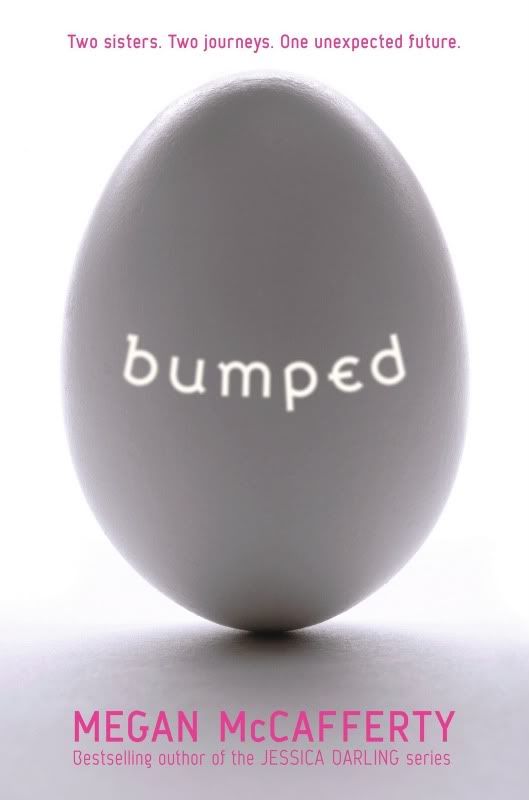
Book Review: Bumped by Megan McCafferty


Bumped by Megan McCafferty

Overall Rating: 3 out of 5

(Author Website) (Amazon Page)

Summary (from Amazon):
When a virus makes everyone over the age of eighteen infertile, would-be parents pay teen girls to conceive and give birth to their children, making teens the most prized members of society. Girls sport fake baby bumps and the school cafeteria stocks folic-acid-infused food.

Sixteen-year-old identical twins Melody and Harmony were separated at birth and have never met until the day Harmony shows up on Melody’s doorstep. Up

to now, the twins have followed completely opposite paths. Melody has scored an enviable conception contract with a couple called the Jaydens. While they are searching for the perfect partner for Melody to bump with, she is fighting her attraction to her best friend, Zen, who is way too short for the job.

Harmony has spent her whole life in Goodside, a religious community, preparing to be a wife and mother. She believes her calling is to convince Melody that pregging for profit is a sin. But Harmony has secrets of her own that she is running from.

When Melody is finally matched with the world-famous, genetically flawless Jondoe, both girls’ lives are changed forever. A case of mistaken identity takes them on a journey neither could have ever imagined, one that makes Melody and Harmony realize they have so much more than just DNA in common.

From New York Times bestselling author Megan McCafferty comes a strikingly original look at friendship, love, and sisterhood—in a future that is eerily believable.
My Thoughts:

I will admit right now though that I have never read a Megan McCafferty novel before. Yes, I must have something wrong with me since this novel made me laugh. Set in a future where anyone over the age of 18 becomes inexplicably infertile from a Virus with no cure. Unlike Wither, McCafferty's dystopia is written as a comedy rather then a drama. However the effects associated with only having underage young adults with the ability to create and carry a child are addressed in a more subtle manner. Melody and Harmony are sixteen and are already being labeled as "too old" to have children. Society's biological clock is ticking loudly for them, and their parents and peers are not letting them forget that.

Harmony arrives on Melody's doorstep with the initial purpose of ministering to her and getting Harmony to join her in Goodside, a religious and isolated part of the modern world which reads fairly similarly to an Amish community. Harmony's only reading material is her Bible, and her entire day is focused on work, prayer, and her purposed fiancee whom she should marry and conceive children with as immediately as possible. Melody's life is filled with academics, sports, and doing anything and everything to ensure the best college and future from her adoptive parents. This also includes being the first to sign a pregg-for-profit contract in her high school. Melody is all ready to conceive a baby, birth it, and give it up as Surrogette.

I found Bumped funny. Both Harmony and Melody felt a bit flat. It isn't because the plot doesn't have plausibility. The consequences of having only teenagers birth children has turned having children into a commercialized business venture rather then a miracle of life. Melody's adoptive parents treat her more as a commodity then a daughter. She is precious to them, but it only seems to come from how much money they can make off of her. Even though Harmony is from a much more religious background she is also being treated as a commodity rather then a person. The whole idea of giving birth has gone so far that thirteen-year-olds are portrayed as wearing "Fun Bumps" and drooling over highly-saught-after teenage boys, like Jondoe, who travels the world and "bumps" with teenage girls. All of which is more then a little disturbing. Not to forget the MASsex parties held by teenagers were girls "bump" with a lot of boy to ensure they all get pregnant at the same time.

However, the way the novel is written makes it frustrating to read. The characters were slow to realizing that their worlds and paths need change, and by the time the more disturbing parts of this society were realized by Melody and Harmony it was the last leg of the book. I realized then that a satisfying conclusion wasn't going to happen,  and the end was, of course, a cliff-hanger. I didn't think this book really needed that. I don't see where else the author has to go. She didn't build up many loose-ends that would require more then one novel. Perhaps if the story had been handled better I would say "go for it". But, I really have to wonder if a sequel  was necessary.

I would honestly say that if you're looking for a comedic dystopian read this book. It was funny. It did speak a lot in terms of social commentary and commercialism.

June 13, 2011

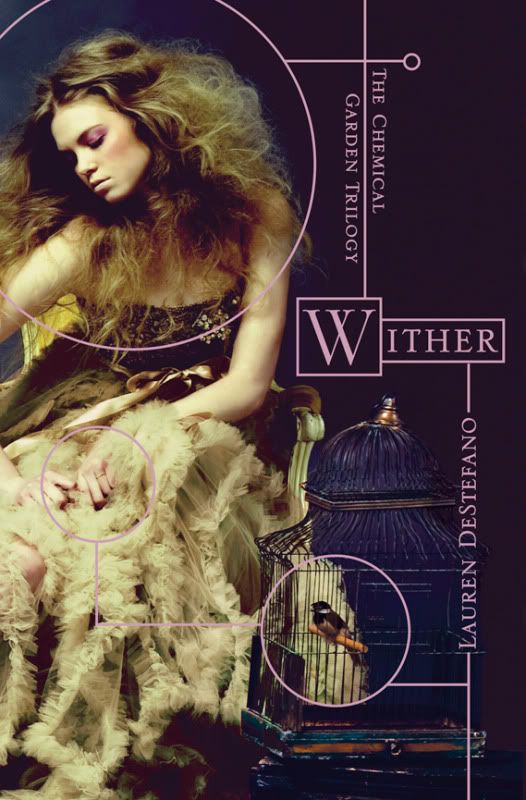
Book Review: Wither by Lauren DeStrenfano

Title: Wither by Lauren DeStrenfano

External Links: (Author Page) (Book Page)

Series: The Chemical Garden Trilogy

Summary (from GoodReads):
What if you knew exactly when you would die? Thanks to modern science, every human being has become a ticking genetic time bomb—males only live to age twenty-five, and females only live to age twenty. In this bleak landscape, young girls are kidnapped and forced into polygamous marriages to keep the population from dying out.
When sixteen-year-old Rhine Ellery is taken by the Gatherers to become a bride, she enters a world of wealth and privilege. Despite her husband Linden's genuine love for her, and a tenuous trust among her sister wives, Rhine has one purpose: to escape—to find her twin brother and go home.

But Rhine has more to contend with than losing her freedom. Linden's eccentric father is bent on finding an antidote to the genetic virus that is getting closer to taking his son, even if it means collecting corpses in order to test his experiments. With the help of Gabriel, a servant Rhine is growing dangerously attracted to, Rhine attempts to break free, in the limited time she has left.

DeStefano's writing is good. That is the first thing you will see when you pick up this book. Good in that she is able to effectively draw you into the world that she's created. A world where women have fallen so far down the social food chain that they've become commodities all over again. A thing to be taken and used for a purpose rather then loved and cherished. You can really understand the way that Rhine has hidden herself away. How dark and frightening her life was before she was captured. I could always imagine Rhine and her brother staying up all night in an attempt to keep Rhine from being kidnapped. How their house was completely closed off except for the basement. How people who aren't rich are living lives that are wrapped around not being kidnapped and barely surviving one day to the next. And, those that are rich live lives are amazingly privileged in more ways then just money and food. Rhine's husband, Linden, is so sheltered in his life he believes that being his wife is all that Rhine has wanted to be.

From the moment she arrives as Gov. Linden's wife, one of four, Rhine has decided to run as far away from her new home as possible. But the longer she stays in her prison the harder it becomes to leave her sister wives. Escaping her father-in-law's ever seeing eyes also becomes difficult for her. By the time I hit the last 1/4th of the novel I was as ready as Rhine was to make her escape. PLEASE woman LEAVE was basically how I felt. For the love of pete stop crying about leaving and LEAVE. I know that escaping for Rhine is hard considering that she had to gain trust in both her husband and her father-in-law in order to even make it outside of her home. But, still. I just wanted Rhine to run away by the end of the novel.

Writing aside I still have no idea what The Chemical Garden is. Absolutely none. As a novel, not apart of a series, I have to say that Wither is a wonderfully well written novel. As a trilogy it's still to be seen just where DeStefano will take her main character Rhine. I mean I read 351 pages and I still can't tell you what the Chemical Garden is, is not very good for a novel that's apart of a trilogy. The second book, Fever, comes out in February 2011. I will definitely be picking it up.

June 7, 2011

Dark YA According to WSJ

On June 4th WSJ posted an article called Darkness Too Visible about dark Young Adult fiction in the market today. The author, Meghan Cox Gurdon, wrote not a review on YA literature, but her opinion on Young Adult fiction. Where she thinks it should be, and how book publishers should be handling it all. She was not writing an article with facts. She is expressing how she felt literature was effecting teens today. I believe that we should not censor material to anyone but ourselves or our own children. You can not censor what other people want to read or experience. You can not speak for other people. Everyone has different ideas as to what is appropriate for their children. It is not up to one person, or even a group of people, to dictate what is good and right for everyone else when it comes to something as personal what a person reads. Many children say they don't like to read, and this is simply not true. Those children have simply not found something to read that interests them enough to want to read it. This is why there are so many different kinds of books out there available in the YA market today.

Yes, not all books on the YA market are about vampires, cutting, drugs or any of those other things that the author of this opinion piece is saying. Even in the comments that same uninformed judgement is being taken in. If all that was being published was about vampires and drugs there would be no room for books of other genres; such as biographies, poetry, non-fiction, romance, slice-of-life, mysteries and comedies. The introduction to the article is simply placed to make the reader believe, if they are not already aware of, the YA shelves in a chain bookstore are all about vampires and dark issue books.  This is a simple improbability, and is really just a statement made to highlight and strengthen one writer's opinion of said YA market.

Now let's go back to the purpose of issue, fantasy, and dystopian fiction on the market today. Issue books that deal with the main premise of teens drinking, dealing with rape, cutting, suicide, loss, and anorexia are things that perhaps adults want to believe aren't happening to teens and children today. Rapes are happening. Teens are dealing eating disorders. Teens are dealing with alcoholism either in their family or in themselves. Teens are dealing with death and mental disorders and they are not being shielded from it simply because they are not reading it in a book. Or if they are not dealing with it themselves teens are seeing others deal these kinds of issues. To keep issues such as these out of books with the idea that it will keep teens from experiencing or dealing with these issues themselves is in itself censorship. To state that these books do not belong in a teenagers hands is to in effect underestimate what teens are experiencing today.

To also state that ALL teens will want to read or relate to these books is also underestimating  teens. There is room for all other types of books out there. There is no absolute. Teens read all kinds of books because what appeals to them and what is being published are making it possible for them to experience life outside of themselves. More often then not books provide an escape from their life. If they are experiencing something similar to what is going on in the book teens can see how someone else, someone much like themselves, is handling it. How they learn or grow or are shaped by what they have experienced. A good YA book will provoke thought and movement in a reader to analyze the characters, the motives, and situations and can in turn push teens to learn how to see outside themselves and understand themselves and others more. Even a villainous person in a novel, if well written, can be seen as more then just a villain, but a character with more facets and motives behind their actions then can been seen on the surface.

In short YA is one of the most diverse genre of books available in publishing today. It is constantly growing, changing, and moving. It is more then what some can see on the surface, and more often then not YA has saved a reader when they needed most to be understood. Even if the person that needed to understand them most was themselves. To state, as Meghan Cox Gurdon did, that teens don't need these kinds of books is not understand that teens need good, well-written, thought provoking literature that relates to them. Teens don't want to read about a 30 year old protag. They want to read about someone their own age. They want to know how someone their age would handle the problem. Teens need YA in order to become life-long readers. Just as children need picture books and babies need board books. In each stage of life books need to relate to that person. Sometimes that person relates to the darker scope of humanity.

For more well thought out responses to the Wall Street Journal article click on these links. They are but the tip of the iceberg:

Twitter feed: #YASaves

The Strangest Situation

Laurie Halse Anderson's Response

Meg Cabot's Huffington Post Article

Edit to Add:

Making the Darkness Visible
Related Posts Plugin for WordPress, Blogger...